Research Overview
Project Scope
During the upcoming months, I will be working on a Production Piece that is inspired by the work I had done during my workshop sessions thus far for Emerging Technologies. For my piece, I have a wide variety of technologies I can utilise and depending of which I choose will determine what the finished work will look like and it’s purpose.
After weighing all my options, I chose to make a 360° video that will make use of the Maya software and it’s tool MASH to create an immersive story environment that can also be an effective method of entertainment for the viewer.
As implied, the purpose of my project is to entertain, however was is not my initial idea for my project. My first idea was an educational video that will portray the 1552 book, A Short Account of the Destruction of the Indies by Bartolomé de las Casas. After taking in the material from the account, I decided against it since there was a great risk when it came to ethical considerations and I worried the finished product could be unacceptable if I portrayed the sensitive events in a way I hadn’t intended.
Instead, while looking for inspiration in short stories, I decided on a telling of the 1819 book, Rip Van Winkle by Washington Irving.
The target audience of the production piece is children aged between 10 and 16 since it teaches the important message of staying adaptable as Rip has to come to terms of how the world has changed since he had been gone. The main character is also relatable with this demographic since in the story, Rip Van Winkle tries to shrug off his work to seek amusement, which is a feeling that many people experience but most commonly during their younger years.
Going back to the topic of adapting, which is relevant to today’s world as it continues to change and evolve. That message of adaptability will encourage people to be more accepting to people who are different to them and ideas they are not familiar with, which is a message is often drowned out by parts of social media, social media that my demographic is often susceptible to.
The use of a 360° environment will allow the message to be clearer as the viewers will be able to step into the shoes of Rip Van Winkle.
UX Considerations
With a 360° video, it is possible to use a VR Headset to receive a greater experience as unlike on a computer you won’t have to click and drag the video to examine the environment, you just have to turn your head. This is a supporting reason why I chose a 360° video as my project.
To enhance the user experience for the final piece, I will be commissioning a narrator from Fiverr to tell the story since the target audience may not fully follow along with the tale if it were just environmental storytelling. If I am unable to acquire a narrator due to financial or any unforeseen reasons, I will use an AI substitute from play.ht which offers free voices which can be customised in terms of intensity, similarity and stability for a broad range of emotions.
For the environmental design, I will take a stylized approach where possible. I say where possible since I may need to get assets online which may be on the more realistic side.
The reason for using a stylized environment is because it will appeal more effectively to my demographic, especially in the younger range. It will also allow me to same some time when texturing my original assets since I could texture them directly in Maya without the need for substance painter. And for the assets I acquire online, my main source will be from Fab, formerly known as SketchFab.
Subtitles could also help the user to follow along with the story, though I did find out that YouTube can add subtitles into 360° videos automatically. If I have enough time, I will add my own subtitles through Adobe Premiere or manually set them in YouTube if possible. The reason why I should do subtitles myself is because sometimes it can take a while for YouTube to transcribe my video or it could get the subtitles wrong.
Ethical Considerations
One way that I will ensure ethical practice during and at the end of my project is by presenting proper credit towards any assets such as models, textures, audio, etc. I will as well be crediting the original author of Rip Van Winkle despite the book being in the public domain. Audio also includes the narration that will be present in the final project that will be commissioned.
Since the target audience of my production piece is quite young, it is important to ensure that none of the content displayed in the environment is intense. This includes to stay away from any dark, violent or tense themes in the environment, music and narration so that the content stays age-appropriate. Though while keeping the project age-appropriate, I also need to stay respectful to the original story by not distorting it or it’s message.
A part of the story that I will leave out is any mention of Rip Van Winkle’s wife’s death while he was asleep since it is a heavy topic to present to a younger audience, but since I’m not distorting the story I won’t be adding her into the ending, I am just simply not mentioning her afterwards.
Project Plan
Timeline
Going into my project’s timeline, I have organised each task that I will have to complete throughout the nine weeks between now and January 6th.
I won’t be doing anything in Maya until I have the script written since that’s when I am able to get a full idea of what scenes I need and what I need to display for the story. After the script is done, however I may start working on the scenes, gathering assets and creating assets while or after I get a commission done for the narration.
After the narration commission has finished I am able to get specific timestamps for the story since the rate at which the voice actor speaks will affect how long each scene will be so the environment keeps up with the story.
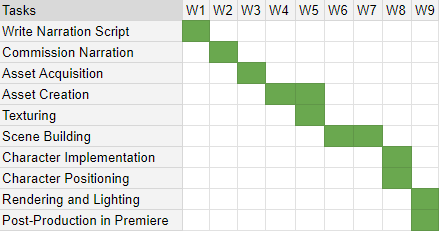
To save production time, I will be positioning the characters like statues throughout the finished piece rather than having animations, this will allow me to more likely get the project finished in time for deadline. This means less time spent on animations and I can render less frames since there can be moments in the 360° video where nothing is moving and there’s just narration in the background, so I can use the same frame when putting the video into premiere, meaning that there is less time rendering.
After the rendering is done, I will import the frames into Adobe Premiere to edit. During this process I will be adding the narration audio into the scene which I will probably have to clip and place parts into the right scenes of the video so that it all matches up properly. I will also be using a fade to black to present an easeful transition in between scenes.
Sound effects and possibly music could also be added to the final video to add a dramatical flair, improving the user experience.
User Stories
Writing User Stories is an effective way of making sure that my final product aligns with the desires of it’s stakeholders. For my assignment, the users of the final video could be young people, their parents or their educators. Because each of these users may be looking for slightly different features from the video, knowing all of these desired features will allow me to implement them during production.
Here are some User Stories for the groups or individuals I stated before:
As a young person, I want to experience an entertaining and engaging 360° video so that I can follow along with the story and go on an adventure along side an interesting protagonist.
As a parent, I want to be able to provide my child access with an age-appropriate experience so that they pick up positive messages that support their emotional development as they learn to be more accepting and adaptable, which will help them with unfamiliar situations and ideas for when they grown up.
As a teacher, I want my students to take part in a virtual learning experience so that they can pick up life lessons along the well as well as become engaged with learning so they can discuss what they have learned in future classes.
Task Management
The way that I will be tracking what tasks I need to do for my project (excluding my Gantt chart) is though a Trello board. I decided to use this since I had become familiar with the website during last year’s collaboration project and a personal project over the summer.
At the beginning of each section that is stated in the Gantt chart I will add all of the tasks that I will need to complete within each section to a “Need to complete” list and as I make progress on each task I move them through “In Process” and “Complete” lists. Each task will also have a rough deadline to note how much time each should take which will also match with a colour coding system that will rank each task in terms of priority.
If there are tasks that aren’t complete by the deadline I may need to mitigate by reviewing and extending some of the deadlines by a week and cutting out low priority tasks to make up for time, this is to ensure that during the project I don’t build up an overwhelming backlog.
Anticipated Challenges and Mitigation
One of the challenges- Time Constraints -I have already mentioned in the previous paragraph where I will mitigate by taking out low priority tasks from the development, but what are the others?
Another challenge I can foresee appearing is gathering a lot of different characters to use in the scenes and rigging them all to position them for the story. A way I can counter this is by getting a couple instead of having each character being unique and replace the texture of the character with a shadow or a specific colour so they can be distinguished.
The next challenge that could come up is financial. What I am talking about is any cost for assets that I may need to make in assurance of making a well put together end product. To mitigate this, I can make simpler assets myself and try to find quality good assets online rather than making a large purchase. I will also make sure to check the licenses for the assets and log the weblinks so I know where to get their creator’s information and credit them at the end of the video.
The last challenge that could affect the project is my overall inexperience with creating environments within Maya which could mean I need to spend more time when making the environments during production. As mitigation, I will take reference of other 3D environments from multiple sources such as cinema, television, video games, other 360° videos, and so forth. I will also use tutorials from YouTube for when I need to use tools that I am unfamiliar with. However, if that is not enough I may have to take out scenes and rearrange on where narrations are used, meaning I would have to create less environments in Maya.
Concept Storyboard
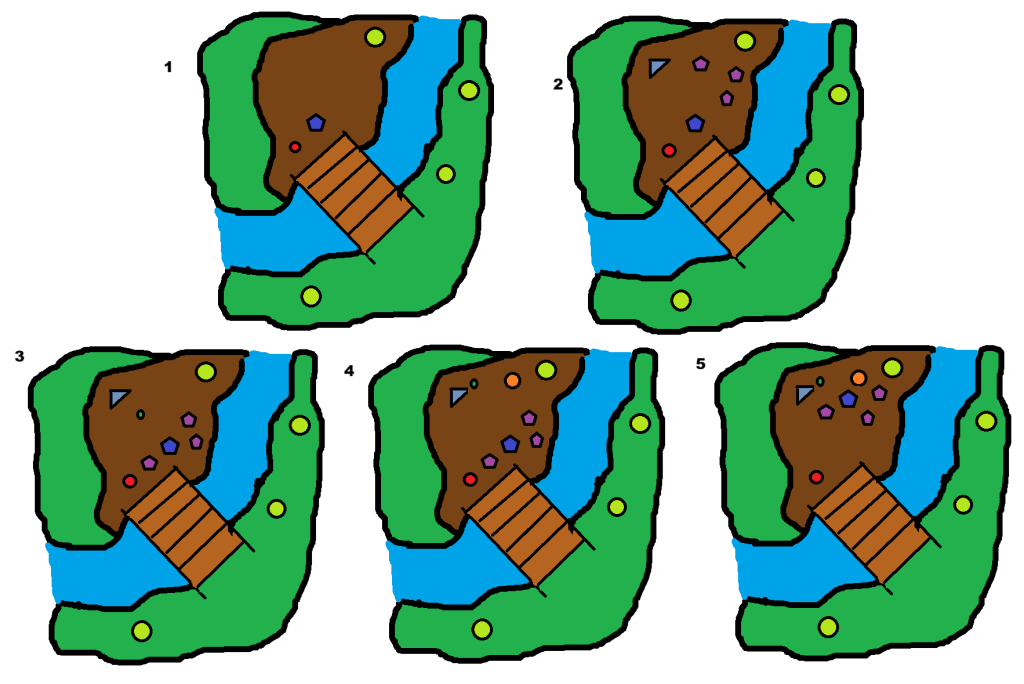
The first environment is Rip Van Winkle’s house as seen below from a top down view. In each of the numbered illustrations the red circle represents the camera, hexagons represent characters and the green circles represent environmental changes as the scene progresses.

The first scene will involve showing Rip and his family, and in the scene Rip will be lazing around while his wife will be taking care of the housework by herself. His wife will scold him for being so carefree, promoting Rip the leave the house. During the scene the narration will be describing Rip’s life and his attitude.
Since it is unclear in the illustrations, I will note that the green circles will be stacks of dishes that will appear when the narration mentions his carefree lifestyle and others needing to do work that he should be doing or assisting with.
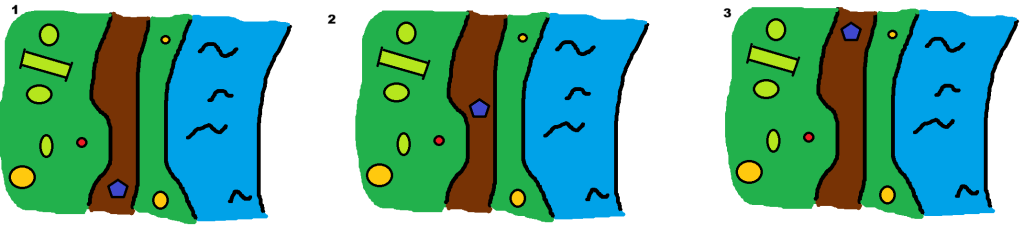
The next environment will include a short scene where Rip Van Winkle walks a forest past to get away from his responsibilities. For the water, I will consult a video tutorial on how to create a river in Maya since I have not done this before in the past.
During this scene, audio will be added that would match the forest environment such as birds chirping, water running and the rustling of trees. These audio files will be acquired online and credited if need be.
In this scene Rip Van Winkle will encounter a group of men playing a game of nine-ball. During which he will join them and after the game he notices their keg, of which he will drink from causing his twenty year slumber.
Similar to the first scene, certain elements will only appear once they are mentioned by the narrator, for example, the scene will start something like “In his attempt to get away from the village, Rip encounters a clearing in the forest. In that clearing he finds a group of men playing a game of nine-ball.”. It is after or during the sentence mentioning the men that they are visible to the viewer, and this is continued throughout the scene as the characters move positions and the keg is noticed by Rip Van Winkle. This approach will make the viewer feel as if they’re experiencing the scene as Rip Van Winkle is as they are only made aware of elements once he is made aware.
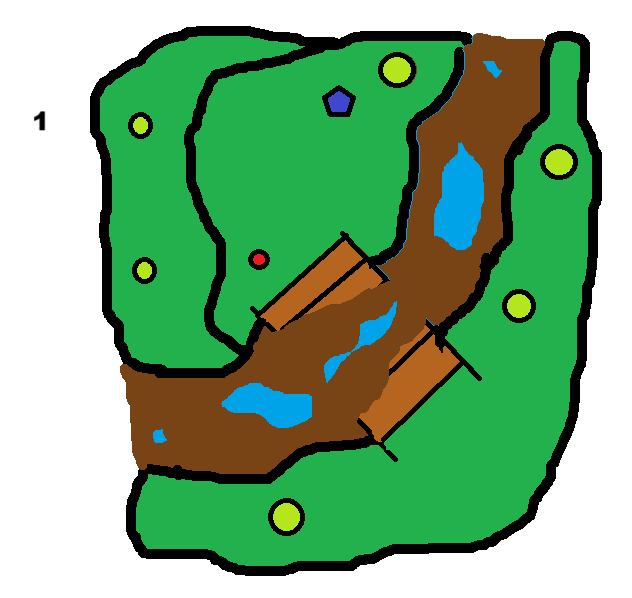
After Rip Van Winkle wakes from is slumber the environment will have changed. The most noticeable change to indicate this that I decided on will be the river drying up, this means that the river audio sound effect will no longer be playing as well.
To avoid flashing lights I won’t be doing a quick timelapse of the day and night changes, instead I could do a slower version so it filters out a epileptic reaction coupled with a fade to black and then switch the scene to 20 years later. Or I could do a timelapse without the night and day changes and just show the changes to the environment in progress such as the river drying, the grass overgrowing and Rip’s facial hear growing out.
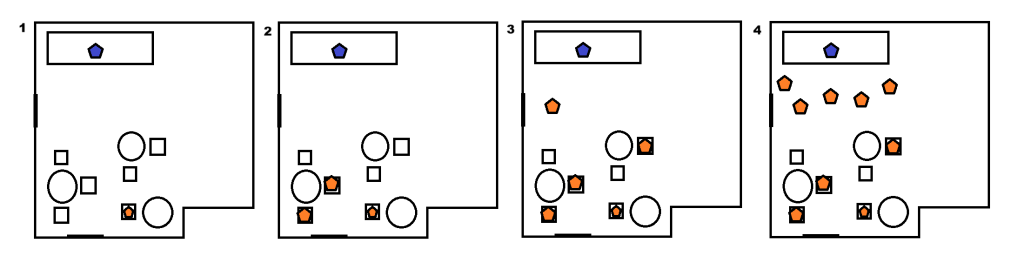
Lastly, in the final scene, Rip Van Winkle returns his village to be completely different than once he left, the narrator will note about his return and how his children has grown. After he goes to the local tavern and tells the adults and children of the village of his tale and how life used to be and how he has been able to accept the changes of the last 20 years.
The tavern scene will show more and more people showing up as he builds a crowd when more people become interested in his tale. Sound effects here should include chatting and the sound of mugs clinking.